
Why You Keep Second-Guessing Yourself (And What’s Actually Going On)
By Melody Wright, LMFT
Have you ever found yourself second-guessing a decision that, for a moment, felt clear?
Like something in you quietly said, okay… this feels right…but then the doubt crept in.
Your chest tightens.
Your mind starts replaying every possible outcome.
You wonder if you missed something, overlooked a red flag, or made the “wrong” choice entirely.
And suddenly, the certainty you felt just moments ago feels hard to trust.
So you go back. You tweak it, rethink it, or maybe you ask someone else what they think, or you sit with it longer than you meant to.
And if you’re being honest, you’re probably tired of constantly going back and forth with yourself.
Tired of finally making a decision… only to start questioning it immediately. Wondering if you missed something, if you’re making a mistake, or if you can actually trust your own judgment.
That kind of mental back-and-forth can become exhausting after a while.
Because it’s not that you can’t make decisions, it’s that your mind keeps pulling you back into doubt. There always seems to be that quiet pull to double-check, to make sure, and to get it right.
And after a while, it starts to feel like something deeper is going on:
Why is this so hard for me?
Why can’t I just trust myself and move on?
If you’ve been stuck in that loop, it’s worth taking a closer look at what’s actually happening underneath it.
At first glance, what’s happening beneath the surface can be easy to misread. It might look like overthinking, self-doubt, or decision anxiety.
But what’s actually happening underneath usually follows a pattern, and when you begin to notice it, it starts to feel a little more understandable.
So keep reading if you want to know what's actually happening underneath the constant second-guessing… because there’s usually more going on than just “indecisiveness.”
What’s Actually Happening Beneath the Surface of Second-Guessing
When you go to make a decision, your brain isn’t just asking what do I want? It’s also quietly scanning for risk like...
Assessing for the safest option.
Trying to determine what will prevent the most discomfort.
Looking for the choice that leaves the least room for regret.
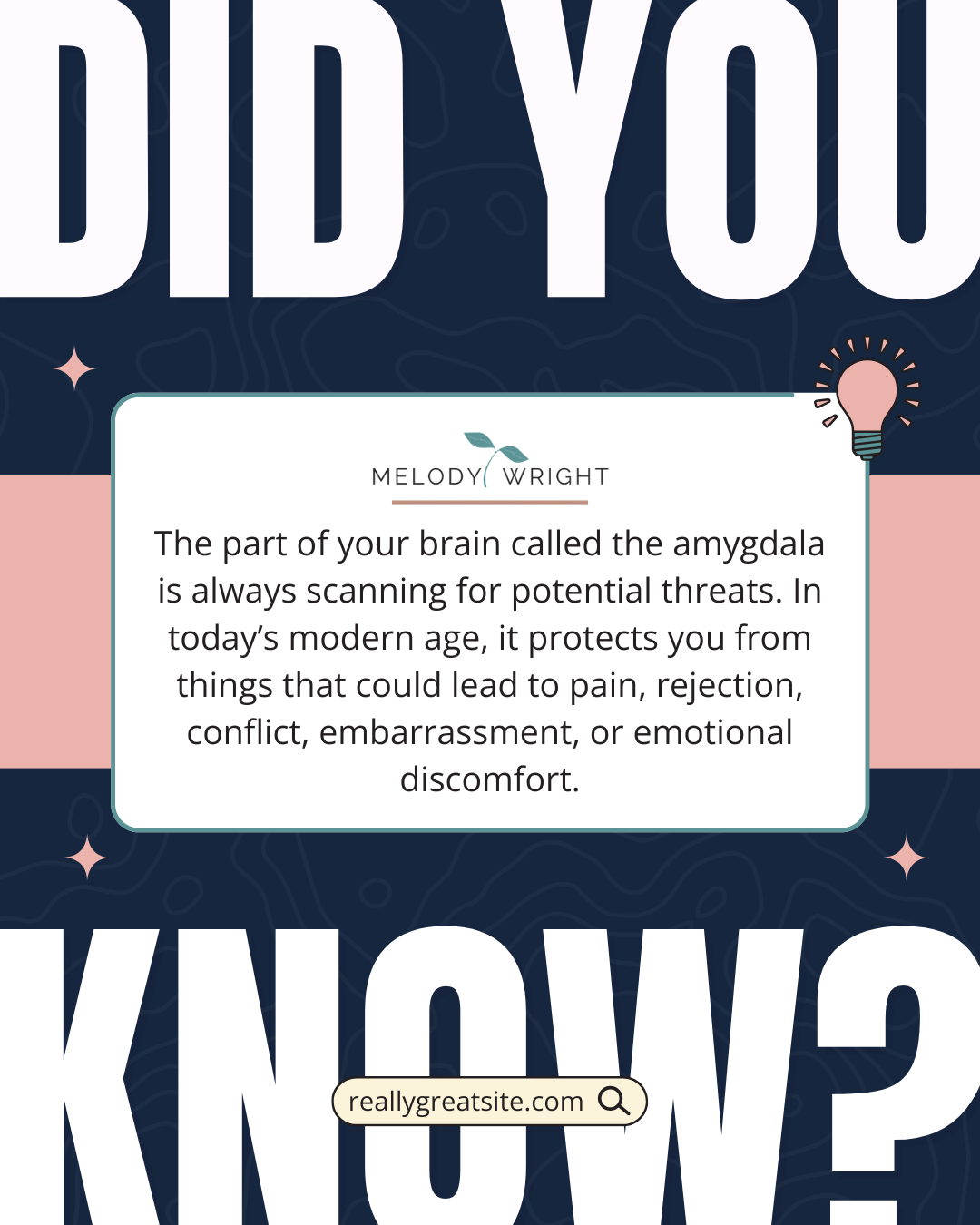
You see, a part of your brain called the amygdala is always scanning for potential threats. In today’s modern age, it protects you from things that could lead to pain, rejection, conflict, embarrassment, or emotional discomfort. And the tricky part is, your brain doesn’t just react to obvious danger. It can also react to subtle things, like tension in someone’s tone, feeling misunderstood, or sensing that someone is upset with you, and your brain starts keeping track of those experiences.
For example, maybe there was a time you trusted yourself, and someone criticized your decision afterward. Maybe you finally spoke up about what you wanted, and it created tension or conflict. Or maybe you made a choice that didn’t go the way you hoped, and you were left feeling embarrassed or blaming yourself afterward.
Your brain remembers that.
So eventually, decision-making can stop feeling like, What do I want? and start feeling more like, How do I avoid getting hurt, disappointing someone, or making the wrong choice?
And that’s usually when the overthinking kicks in.
The replaying.
The double-checking.
The trying to “figure out” the perfect decision before you make it.
Not because you’re incapable of making decisions, but because some part of your system has learned that decisions can carry emotional consequences.
That’s part of why decision-making can feel so exhausting, especially if you already struggle with anxiety, self-doubt, or feeling emotionally on edge a lot of the time.
I want you to know that this is not something you consciously choose, but it’s something your nervous system defaults to because it’s trying to protect you.
So, what starts as protection shapes how you move through your decisions in your day-to-day life.
The Pattern That Keeps Pulling You Back Into Overthinking & Second-Guessing
What started as your nervous system trying to protect you can slowly turn into a pattern of second-guessing yourself in your everyday life.
You make a decision, but instead of feeling settled afterward, your mind keeps circling back to the situation or decision by:
Replaying the conversation.
Re-reading the text.
Wondering if you said the wrong thing
Missing something important
Handling it badly somehow
Other subtle signs of a second-guessing pattern can look like:
Needing reassurance from other people by wanting someone to tell you that you made the “right” choice or responded the “right” way.
Changing your mind at the last minute, even when nothing actually changed except the doubt you started feeling inside.
And without even realizing it, that loop starts reinforcing itself.
What's really interesting about your brain is it’s always learning through repetition, through something called neuroplasticity. So, your brain and nervous system get more efficient at whatever you practice most. So if you repeatedly go back and question yourself after making a decision, your brain starts to learn: This is what we do when uncertainty shows up.
Over time, it can start feeling automatic, like second-guessing yourself is just part of your personality or “how your brain works.”
But usually, it’s not that simple.
Usually, there’s more underneath that pattern than people realize, and some of the reasons you second-guess yourself may not be as obvious as you think.
And truthfully, the loops of overthinking can be challenging to manage without the right tools. If you would like to learn how to support yourself when your mind won’t stay put, check out our blog, 6 Ways to Return to the Present When Your Mind Won't Stay Put.
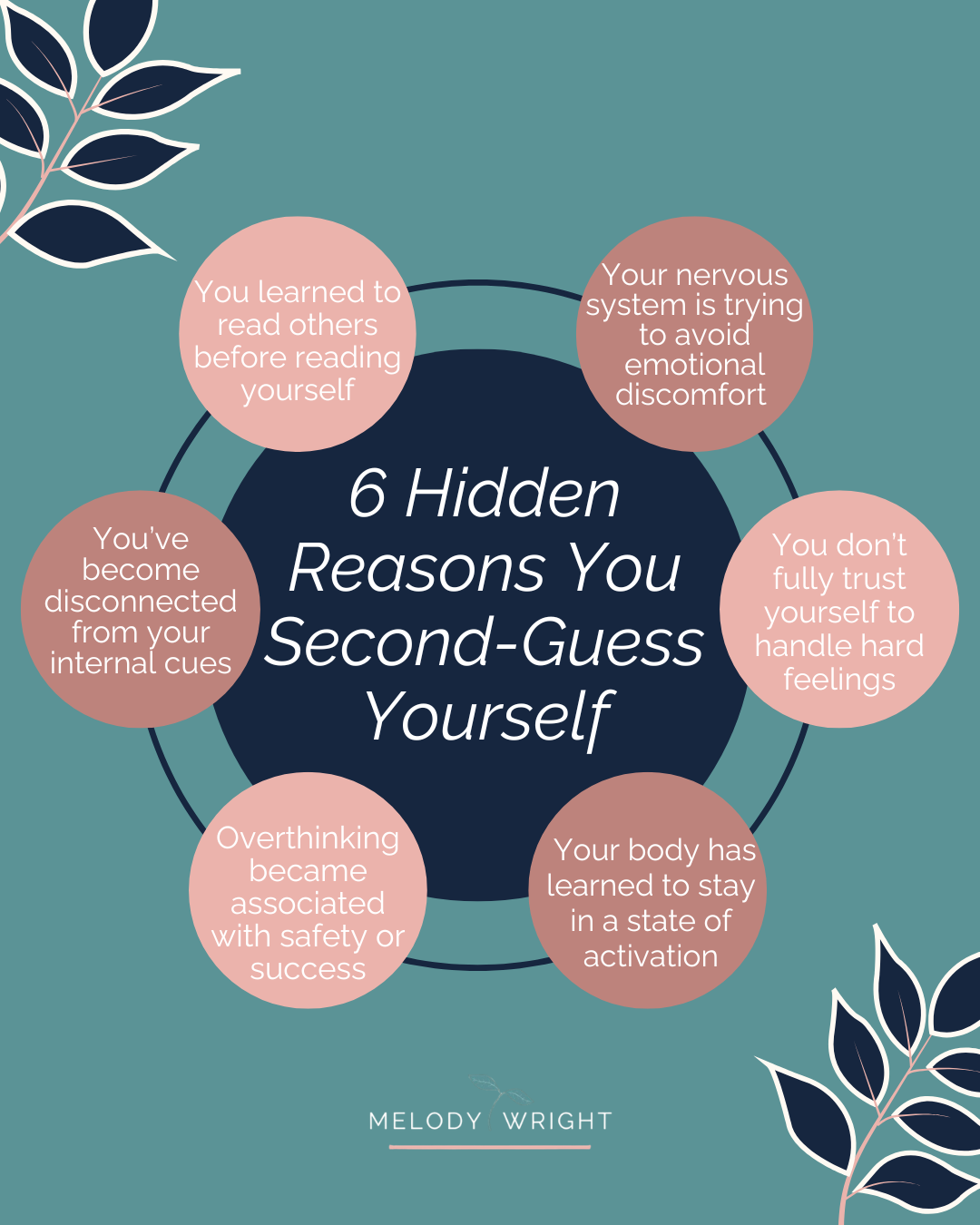
6 Hidden Reasons You Second-Guess Yourself
When you start to look at second-guessing through the lens of your nervous system, past experiences, and learned protective patterns, second-guessing begins to feel less random and more connected to the ways you’ve learned to move through the world.
It’s not just one thing. It’s usually a combination of patterns that have built over time, often in ways that are easy to miss.
Here are a few of the hidden reasons that might be showing up for you:
1. You learned to pay attention to everyone else’s emotional cues before your own internal ones
For some people, second-guessing starts with becoming highly attuned to other people’s emotions, reactions, and needs. This is especially common in anxious attachment, where your nervous system learns early on that connection and emotional safety may depend on staying aware of what other people are feeling.
So instead of feeling grounded in your own preferences, your attention automatically shifts toward managing the emotional environment around you.
You may notice yourself:
Softening your opinions to keep the peace.
Replaying conversations to make sure you didn’t upset someone.
Adjusting decisions based on how you think another person might react.
Feeling responsible for other people’s comfort, disappointment, or emotional responses.
Struggling to tell the difference between what you actually want and what feels safest relationally.
From a somatic perspective, this can become a form of hypervigilance, where your body stays focused on scanning for emotional cues, shifts in tone, or signs of disconnection. Over time, your attention becomes externally focused, which can make it harder to stay connected to your own internal cues, needs, and instincts.
And when your decisions are constantly filtered through other people’s emotional responses first, even simple choices can start to feel emotionally loaded.
2. Your nervous system is trying to avoid emotional discomfort
A lot of the time, the pressure behind second-guessing isn’t actually about the decision itself. It’s about the emotional experience your brain is trying to prevent afterward.
Feelings like:
Regret
Guilt
Embarrassment
Disappointment
Conflict
Feeling misunderstood
Your nervous system naturally wants to move away from experiences that feel emotionally painful or unsafe. So your mind keeps searching for the “right” choice, hoping it can find the one decision that prevents discomfort entirely.
But this is where people often get stuck: They learn to see certainty and avoiding conflict as the safest option.
And when your brain believes certainty is what keeps you emotionally safe, it becomes very hard to stop analyzing, replaying, or trying to predict every possible outcome before making a decision.
3. You don’t fully trust yourself to handle hard feelings
Sometimes the deeper fear underneath second-guessing isn’t actually: “What if I make the wrong choice?”
It’s: “What if I make the wrong choice and I can’t handle what comes next?”
That’s a very different kind of fear.
You see, self-trust is not just about trusting your decisions. It’s also about trusting your ability to navigate disappointment, grief, uncertainty, conflict, or repair if things don’t go as planned.
When that internal trust feels shaky, your nervous system will respond by trying to gain more control before acting. That can look like overanalyzing, freezing, reopening decisions repeatedly, or struggling to fully commit to a choice.
But this is not because you’re incapable, but because some part of you is trying to reduce emotional risk before moving forward.
4. Your body has learned to stay in a state of activation
If your nervous system is used to stress, pressure, overthinking, or constantly preparing for what could go wrong, calm can actually start to feel unfamiliar.
So when you finally make a decision, your body may not fully register it as “safe” to settle.
Instead, your system keeps searching.
You recheck
You rethink
You revisit the conversation
You look for reassurance
You reopen the decision again
From a somatic perspective, this often happens when the body becomes more familiar with activation than regulation. The mind interprets continued checking as productive or protective, but underneath it is a nervous system that has difficulty tolerating stillness, uncertainty, or completion.
So the loop continues, not necessarily because the decision is wrong, but because your body has learned that staying mentally activated feels safer than allowing uncertainty to exist.
5. Overthinking became associated with safety or success
For many people, overthinking started as an adaptive strategy.
Maybe you realized that being highly aware helped you avoid criticism.Maybe you thought that thinking through every possibility helped you stay prepared.Maybe anticipating problems helped you feel more in control growing up.
So your brain learned that overthinking keeps you safe.
And to be fair, sometimes it probably did help you survive certain environments or experiences.
But the nervous system doesn’t always recognize when a protective strategy is no longer helping in the same way. So even when constant analyzing starts creating stress, exhaustion, or disconnection from yourself, your brain may still interpret it as responsible, productive, or necessary.
6. You’ve become disconnected from your internal cues
Self-trust relies heavily on interoception, which is your ability to notice and interpret the internal signals coming from your body.
This feels off
I feel open here
I feel constricted here
This feels grounding
But if you’ve spent years overriding your needs, minimizing your feelings, prioritizing survival, or staying focused on everyone else around you, those internal signals can become harder to access. Instead of trusting how something feels, you keep searching for certainty through overthinking.
That’s part of why second-guessing can feel endless sometimes. Your mind is trying to solve something, and your nervous system is still learning how to feel safe enough to trust.
Grounding is a great way to begin learning how to reconnect with yourself and your internal cues. To learn more about how to do this, check out our blog, Grounding Techniques to Calm Your Nervous System.
Final Reflections
If you’ve been struggling with overthinking, self-doubt, or difficulty trusting your decisions, I want you to know that these patterns are more common than you might think. It just means your brain and your body have learned ways to protect you, to anticipate, and to try to keep you safe.
And while those patterns may not feel helpful right now, they make sense when you look at where they came from.
Remember, the goal isn’t to force yourself to “just trust yourself” overnight, but rather to start understanding the patterns you’ve been moving through, and gently begin shifting them in a way that actually feels sustainable.
If this is something you’ve been struggling with, you don’t have to figure it out on your own. At Life By Design Therapy™, our Holistic & Somatic Therapists will support you in understanding the patterns behind second-guessing and help you develop more consistent, embodied self-trust over time.
If you’re ready to get started, CLICK HERE to book your free phone consultation.
This Week's Affirmations
I am learning to stay with my decisions, even when it feels uncomfortable.
I can move forward without having all the answers.
My first instinct is worth listening to.
It’s safe for me to let a decision be enough.
I can trust myself to handle whatever comes next.
Additional Resources
If you’re interested in continuing to explore your relationship with self-trust, the resources below can be a helpful place to start.
The Untethered Soul: The Journey Beyond Yourself by Michael A. Singer
Radical Acceptance: Embracing Your Life With the Heart of a Buddha by Tara Brach
Overcome Overthinking and Anxiety in Your Relationship By Robert J Charles
**Some product links are affiliate links, which means we'll receive a commission if you purchase through our link, at no extra cost to you. Please read the full disclosure here.

