
How to Stop Second-Guessing Yourself and Feel More Confident in Your Decisions
By Melody Wright, LMFT
If you've ever spent more time worrying about making the wrong decision than actually making the decision itself, you know how exhausting it can be. The mental back-and-forth, the constant weighing of options, and the fear of getting it wrong can leave you feeling stuck before you've even made a choice.
And if you’ve been second-guessing yourself lately…especially when it comes to making decisions…you’ve probably asked yourself some version of:
“Why can’t I just trust myself?”“Why does everything feel so hard to decide?”“Why do I feel like I’m going to get it wrong?”
And most advice will tell you to be more confident, to think it through, and to just go with your gut.
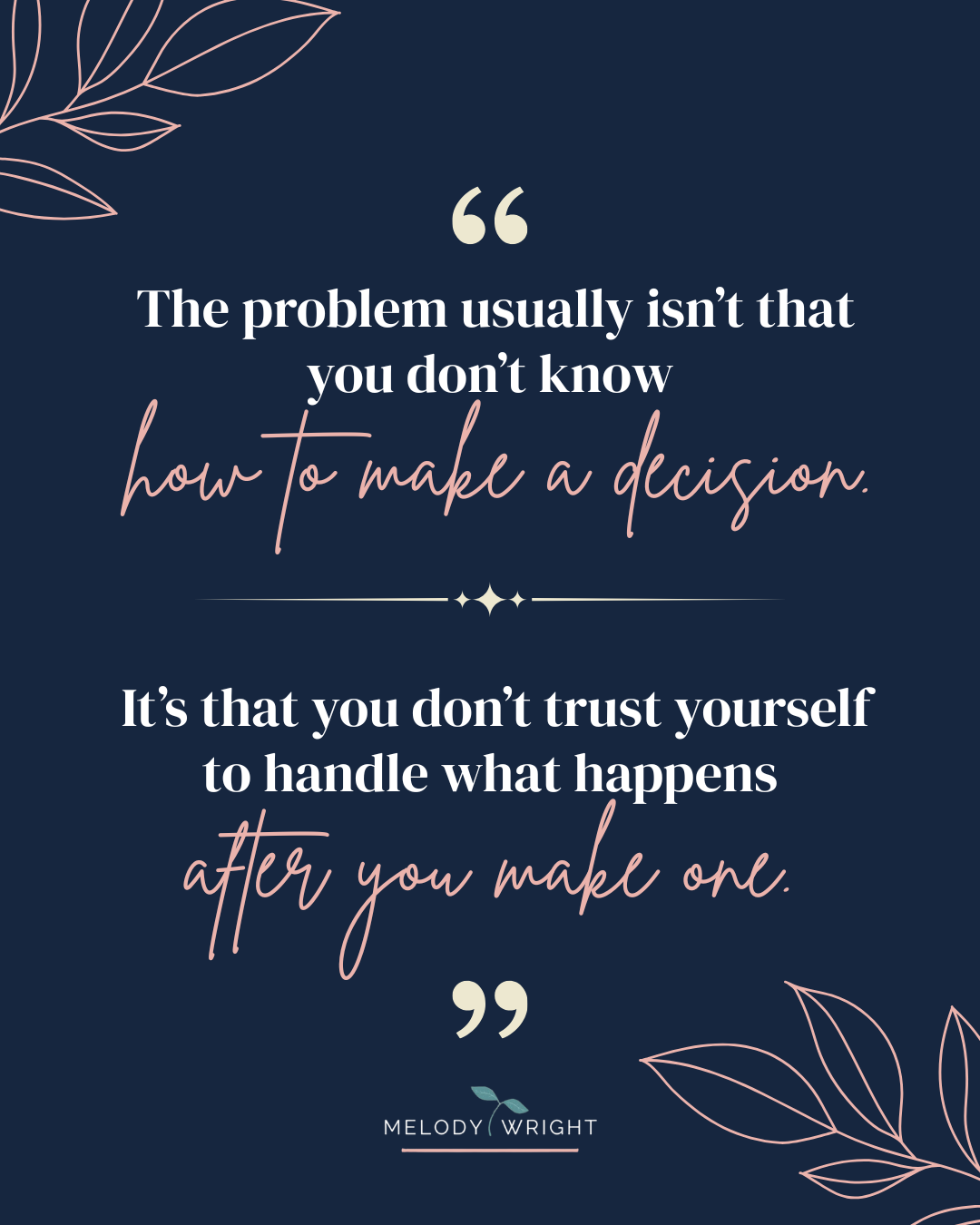
But if that actually worked, you wouldn’t still be here… going back and forth in your head. Because the problem usually isn’t that you don’t know how to make a decision.
It’s that you don’t trust yourself to handle what happens after you make one.
Why You Keep Second-Guessing Yourself
Remember, these patterns don’t come out of nowhere. It builds over time and often in ways that don’t feel obvious while they’re happening. But before we even talk about how to start trusting yourself again, it helps to understand where this comes from.
For a lot of people, second-guessing yourself is shaped by earlier experiences, like:
Being taught to rely on others over yourself
Having your needs or feelings dismissed or questioned
Being rewarded for being “easy,” “good,” or accommodating
Learning that getting it wrong had consequences
Time and time again, your nervous system adapts as a way to protect yourself, so instead of asking “What do I feel?”, you start asking “What’s the right decision?”
And that shift changes everything.
Because when your focus becomes getting it right instead of trusting yourself, decision-making can start to feel heavy. Even small choices can feel overwhelming, and it makes sense that you would start second-guessing yourself or looking outside of yourself for reassurance.
At some point, choosing stopped feeling simple and started feeling like a risk.
If this resonates with you, you may want to explore the deeper roots of these patterns. In our blog, The Hidden Reasons You Second-Guess Yourself, we take a closer look at how past experiences, nervous system responses, and learned survival strategies can shape self-doubt and make trusting yourself feel difficult. You can read it here:The Hidden Reasons You Second-Guess Yourself.
What Happens After a Decision Matters More Than the Decision Itself
You don’t learn to trust yourself by making the “right” decision every time. You learn to trust yourself by listening inward, making the best choice you can with the information you have, and discovering that you can handle what comes next.
In those moments where things don’t go the way you hoped…and your first instinct is to replay it, pick it apart, or tell yourself you should have known better. That’s usually the moment things start to break down. Not necessarily because of the decision itself, but because of how you respond to yourself afterward.
So rebuilding self-trust doesn’t mean getting better at choosing.
It means learning to respond differently when a choice doesn’t go as planned.
It looks like not turning against yourself. Not spiraling into “I messed this up,” not using it as proof that you can’t trust your own judgment, and not using it as proof that you can’t trust your own judgment.
And over time, something starts to shift.
Because your system begins to realize:
“Even if this doesn’t go perfectly… I’m still okay.”
“I’m not on my own in this.”
And that’s where trust actually starts to rebuild. Not when you get it right, but when you realize you can handle it, even if you don’t.
Building Self-Awareness as a Foundation for Self-Trust
Rebuilding self-trust doesn’t usually feel like a big, obvious shift. It’s usually subtle and comes from developing self-awareness.
So, it might look like one of those moments where you catch yourself right before you spiral into second-guessing… and instead of following it, you pause.
Or a moment where you notice what you’re feeling and, for once, you don’t immediately try to figure out the “right” decision, and you just sit with it for a second.
Maybe it’s choosing something small, like what you want or need, and not going back to question it five times after.
None of it feels dramatic, and you might even miss it if you’re not paying attention. But over time, implementing some small shifts can help you begin to change how you move through decisions.
So, if you’re starting to recognize this pattern in yourself, I want you to know that you don’t need to fix it overnight. You just need a place to begin.
If you'd like to explore that a little deeper, we recently wrote a blog called The Journey Within: 10 Ways to Conquer Self-Doubt. In it, we walk through practical ways to build self-awareness, challenge self-doubt, and reconnect with your own inner wisdom. You can read it here:The Journey Within: 10 Ways to Conquer Self-Doubt.
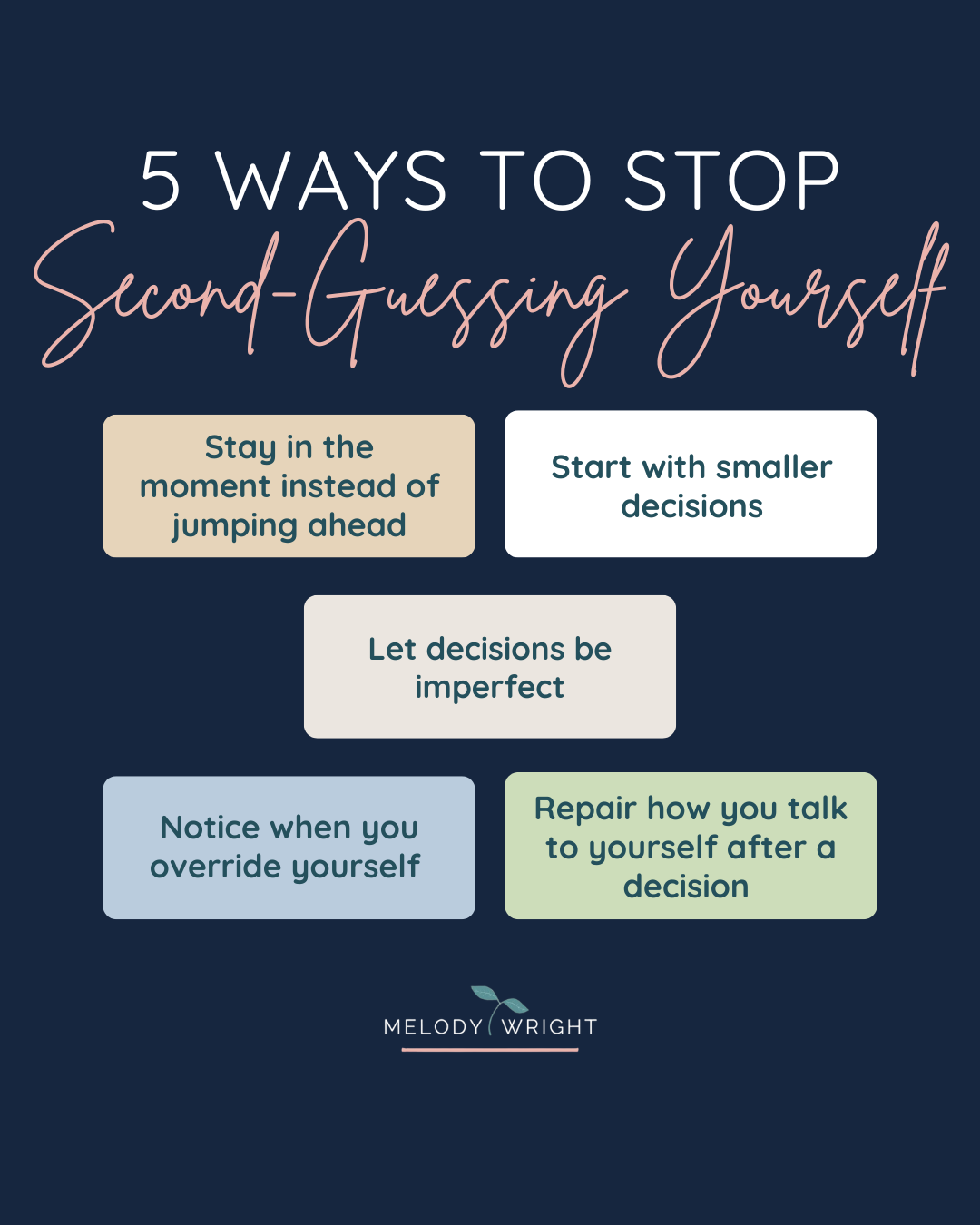
7 Ways to Stop Second-Guessing Yourself and Start Trusting Your Decisions
If you've been struggling to trust yourself or find yourself constantly questioning your choices, here are a few ways to help you begin rebuilding self-trust and easing some of that uncertainty.
1. Start noticing before you try to fix it - Pay attention to when you second-guess yourself, especially around decision-making, because awareness is what helps you start trusting yourself again.
2. Ask what you’re actually afraid of - Instead of asking “What’s the right decision?” ask: “What am I afraid will happen if I choose this?” Is it fear of embarrassment, disappointing someone, or maybe conflict? Naming it can change everything.
3. Stay in the moment instead of jumping ahead - Second-guessing often pulls you into the future, focusing on what could go wrong or what you might miss. Self-trust, however, is built in the present. As you're making decisions, gently notice what's happening in your body, your thoughts, and your emotions.
4. Start with smaller decisions - If trusting yourself feels hard, you don’t have to start big. You can build confidence in your decision-making with low-stakes choices.
5. Let decisions be imperfect - You don’t build self-trust by always getting it right. You build it by learning you can handle it when things don’t go as planned.
6. Notice when you override yourself - Pay attention to the moments you ignore what you feel. That’s where trust starts to break down.
7. Repair how you talk to yourself after a decision - This is the biggest one. If you tend to shame yourself after making a decision, that’s what keeps you stuck. Self-trust is built in how you respond to yourself afterward.
Learning to Trust Yourself Again
At first, it might not feel like much. You might still second-guess yourself when making decisions, and you might still feel unsure. And that's okay!
But as you start integrating these tools into your everyday life, you’ll start to notice shifts like more awareness or a more grounded internal space before responding.
And over time, this becomes your baseline for confidence and decision-making. Maybe not perfect certainty, but enough self-trust to make decisions without constantly questioning yourself, even when things don’t go the way you hoped.
Final Reflections
If you’ve been telling yourself that you’re bad at decision-making or that you can’t trust yourself, it makes sense why you might feel stuck. But that doesn’t mean you truly are stuck
Remember, you don’t learn to trust yourself by making perfect decisions. You build trust with yourself in the moments where things don’t go how you expected… and you don’t tear yourself apart for it afterward.
Sometimes the pattern of second-guessing yourself runs deeper, connected to past experiences, relationships, or a long history of feeling disconnected from your own needs. And in those moments, having support can make a real difference.
At Life By Design Therapy, we help clients rebuild self-trust and feel more confident in decision-making through somatic and holistic therapy by helping you reconnect with your body, your emotions, and your internal sense of safety.
Because trusting yourself isn’t about forcing confidence, it’s about creating enough safety within yourself that you can actually hear your own voice again.
This Week's Affirmations
I can make a decision and handle whatever comes next.
I don’t need to overthink to make a valid choice.
I can respond to myself with care, even when things don’t go as planned.
I don’t need to get every decision right to trust myself.
I am not defined by past decisions I regret.
Additional Resources
If you’re interested in continuing to explore your relationship with self-trust, the resources below can be a helpful place to start.
The Untethered Soul: The Journey Beyond Yourself by Michael A. Singer
Radical Acceptance: Embracing Your Life With the Heart of a Buddha by Tara Brach
Overcome Overthinking and Anxiety in Your Relationship By Robert J Charles
**Some product links are affiliate links, which means we'll receive a commission if you purchase through our link, at no extra cost to you. Please read the full disclosure here.

