
Why Self-Criticism Feels Familiar and Self-Compassion Doesn't
By Melody Wright, LMFT
Imagine you're cooking dinner and accidentally grab the handle of a hot pan.
You feel the burn and immediately pull your hand away. You run it under cool water, find something to treat it, and you're probably a little more careful the next time you reach for that pan.
When we experience physical pain, we instinctively know that whatever is injured needs care and attention. However, when we experience emotional pain, we don’t always respond the same way – with care and attention.
For example, instead of responding to ourselves with care, our minds often begin looking for everything we did wrong, like:
Replaying a mistake that was made for the rest of the day.
Questioning what we could have done differently when we think we let someone down.
Focusing on everything we didn't finish after an exhausting week
If this were a burn on your hand, you wouldn't keep touching the hot pan to teach yourself a lesson. Yet when the pain is emotional, many of us do something surprisingly similar by returning to it again and again through criticism, shame, and overthinking.
Now I understand, being kind to yourself sounds like it should come naturally. But if you’ve ever found yourself in this position, you know it can be anything but easy.
What if I told you that there might be a reason for that…and it’s not your fault.
For a lot of us, self-criticism developed as a way of coping, protecting ourselves, or making sense of difficult lived experiences. Understanding where these patterns come from can help us make sense of why self-compassion sometimes feels so difficult. From there, we can begin to notice what gets in the way, how those patterns continue to show up in our lives, and what it might look like to respond to ourselves differently.
How Childhood Experiences Shape Negative Self-Talk
Self-criticism rarely develops out of nowhere. More often, it's something we learn over time.
As children, we naturally adapt to the environments we're growing up in. Over time, those early ways of coping can shape how we respond to ourselves when things feel hard.
For example:
A child who is frequently corrected may begin looking for their own mistakes before someone else points them out, hoping to avoid being corrected again.
A child growing up in a home where emotions often shifted without warning may learn to watch tone of voice, facial expressions, and mood changes, hoping to stay one step ahead.
A child whose family is already overwhelmed may avoid asking for help because they don’t want to add another problem. As they grow older, asking for help may feel selfish, and struggling may feel like something they should be able to handle on their own.
These aren't personality flaws. They're adaptations.
As children, those adaptations often make sense. They help us stay connected, avoid conflict, or find a sense of safety in the world around us.
As we grow older, though, those same adaptations can quietly become the rules we live by:
Don’t make mistakes.
Don’t ask for too much.
Keep everyone happy.
Take care of it yourself.
Over time, those rules can become the voice we hear inside our own heads.
That critical voice may be painful, but it isn’t pointless.
It's often trying to protect you from something it learned to fear, whether that's criticism, conflict, rejection, disappointment, or feeling like your needs were too much.
Sometimes that voice isn't even fully your own. It may sound a lot like the parent, caregiver, teacher, or other influential adult whose words or expectations became internalized over time. As children, we naturally absorb the messages we're given, especially when they feel connected to love, approval, or safety. Eventually, those messages can become the way we speak to ourselves.
That's why replacing self-criticism with a positive affirmation rarely creates lasting change, even though we may want it to. Before that critical voice can soften, it helps to understand where it came from, what it's trying to protect you from, and whether the messages it's repeating still belong in your life today.
Why Letting Go of Self-Criticism Can Feel Risky
If self-criticism has been part of your life for a long time, it's understandable that the idea of letting it go might feel uncomfortable.
You may even wonder, "If I'm not hard on myself anymore, what will keep me accountable?"
For so many of us, that critical voice has become tangled up with responsibility, motivation, and doing the right thing. So when we hear the words self-compassion, we might worry it means excusing harmful behavior, avoiding responsibility, or pretending everything is okay.
That isn't what self-compassion means in a therapeutic context.
Self-compassion allows us to look honestly at what happened without turning the experience into an attack on who we are.
So, it sounds less like, "It doesn't matter that I hurt someone," and more like, "I don't feel good about what happened. I want to understand it, repair what I can, and respond differently next time."
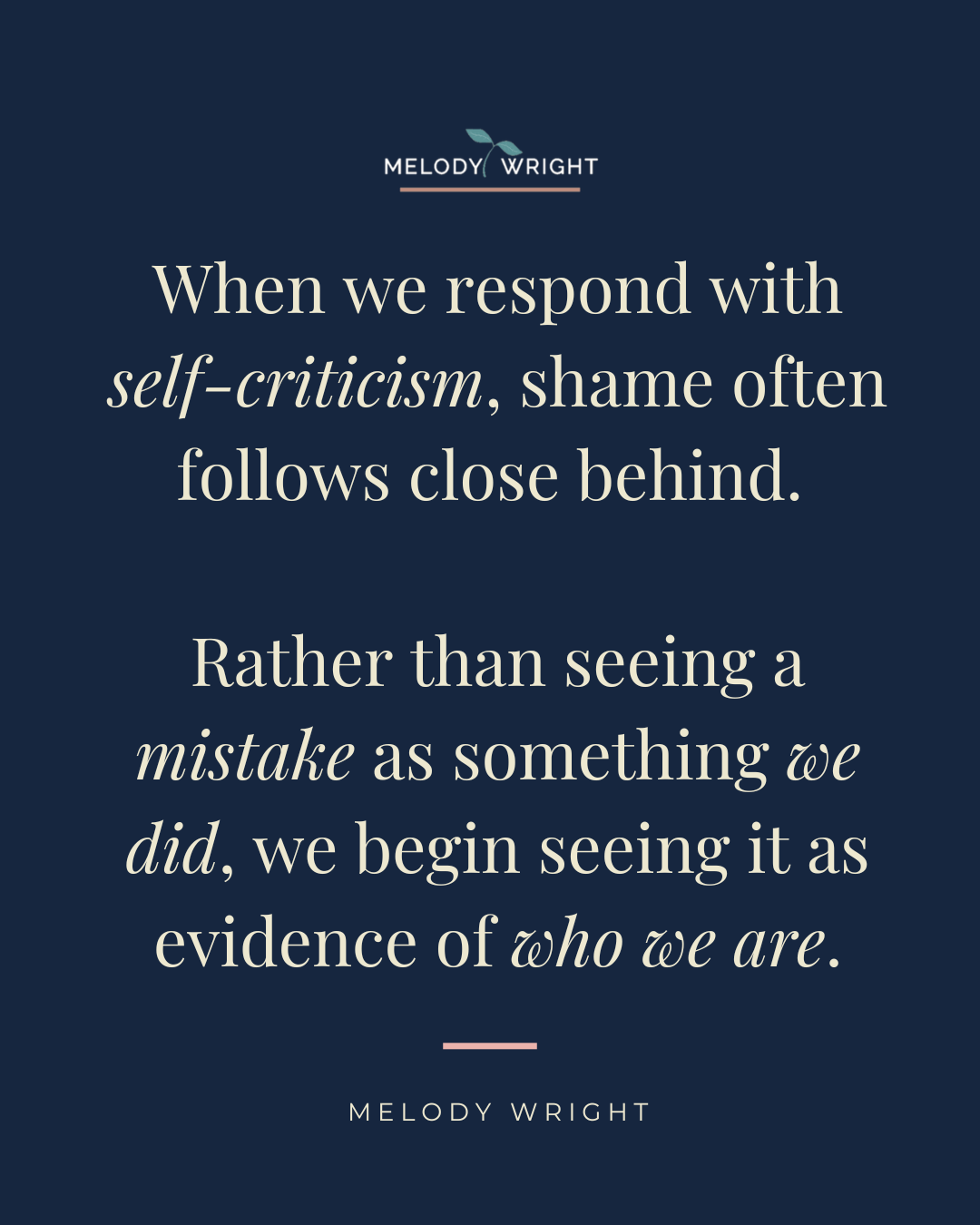
When we respond with self-criticism, shame often follows close behind. Rather than seeing a mistake as something we did, we begin seeing it as evidence of who we are.
Shame sounds like: “I made a mistake because there’s something wrong with me.”
Self-compassion makes room for a different response: “I made a mistake. What happened? What needs repair? What support would help me respond differently next time?”
Even when we understand that difference, choosing compassion over criticism can still feel risky.
You may be wondering what happens if you stop relying on the patterns that have helped you feel in control or keep moving forward.
If being hard on yourself is what pushes you to do better, what happens if you respond with compassion instead?
If anxiety is what reminds you to check everything three times, what happens when you relax?If guilt is what keeps you available to everyone, what happens if you stop carrying it?
And if these are the questions you’re asking yourself right now, they make sense. When these patterns have helped you feel productive, responsible, or in control, letting go of them can feel uncomfortable…even when you know they’re no longer serving you.
After all, these patterns may have helped you get through difficult moments, meet expectations, or feel more in control. At the same time, they may make it harder to rest without guilt, trust yourself without second-guessing, or let go of a mistake after you’ve already done what you can to repair it.
The goal isn't to stop caring, but rather it's to understand that caring and self-punishment aren't the same thing.
Why Self-Compassion Sometimes Brings Up Grief
One surprising thing about practicing self-compassion is that it doesn't always bring immediate relief. Sometimes, it brings grief.
It might seem surprising at first, but here's why.
As you begin responding to yourself with more compassion instead of criticism, you may start looking at your past through a different lens. Experiences you've always dismissed, justified, or blamed yourself for can begin to feel different.
In therapy, there are moments when someone suddenly realizes how young they were when they became responsible for a parent's emotions. They recognize that being "easy" often meant keeping their own needs private. They begin to understand that what they always thought of as independence may have developed because depending on other people didn't feel reliable.
Those realizations can be incredibly validating. They can also bring a deep sense of grief.
You may find yourself trying to hold more than one truth at the same time. My parents loved me, and there were ways they weren’t able to show up for me. They were struggling and doing the best they could, and I still needed more than they were able to give.
Holding those truths together can be painful. It can mean grieving the childhood, relationship, or experiences you needed but didn’t have. That grief doesn’t require you to decide that your parents were bad people or that nothing good existed. It means making space for the reality that something important may have been missing for you.
For many of us, our earliest relationships are where we first learn what love, safety, comfort, and care feel like. When some of those needs weren’t met, we can carry that with us into adulthood, including in the way we relate to and care for ourselves.
And sometimes, healing means learning to hold both: They may have done the best they could, and I can still acknowledge that I needed more.
These are questions therapists hear often, but the goal isn't to decide whether your parents were "good" or "bad." It's to make space for the full picture.
A caregiver may have loved you deeply and still been unable to consistently meet your emotional needs. They may have been doing the best they could with their own history, health, or circumstances. At the same time, you may still carry the effects of what their best couldn't provide.
Both of those things can be true.
Understanding their experience doesn't require you to minimize your own.
Sometimes self-compassion simply means allowing yourself to acknowledge the impact of what happened without immediately explaining it away, dismissing it, or telling yourself it shouldn't have mattered.
Practicing Self-Compassion When It Doesn't Feel Natural
Being compassionate toward yourself can sound simple: offering yourself the same patience, understanding, and care you might naturally extend to someone you love. But for many people, actually relating to themselves this way can feel surprisingly uncomfortable.
Instead of feeling reassuring, self-compassion may bring up tension, irritation, numbness, embarrassment, or even resistance. And often, that discomfort has less to do with whether you’re “doing it right” and more to do with what you’ve learned about how you’re supposed to respond to yourself.
From a somatic perspective, those reactions aren't something to push past; they're something to pay attention to.
Your body is always responding to what it has learned over time.
So, if warmth and care felt inconsistent growing up, receiving them (even from yourself) can feel unfamiliar. If being emotionally vulnerable was met with criticism, dismissal, or rejection, turning toward your feelings may cause your body to brace before your mind even realizes what's happening.
You might find yourself saying, "It's okay to rest," while noticing tightness in your chest or an urge to get up and be productive.
Intellectually, you might know you’re safe, but your nervous system may still be responding to what it learned a long time ago.
But please know that doesn't mean you're failing at self-compassion. It simply means your body learned a way of protecting you that once made sense.
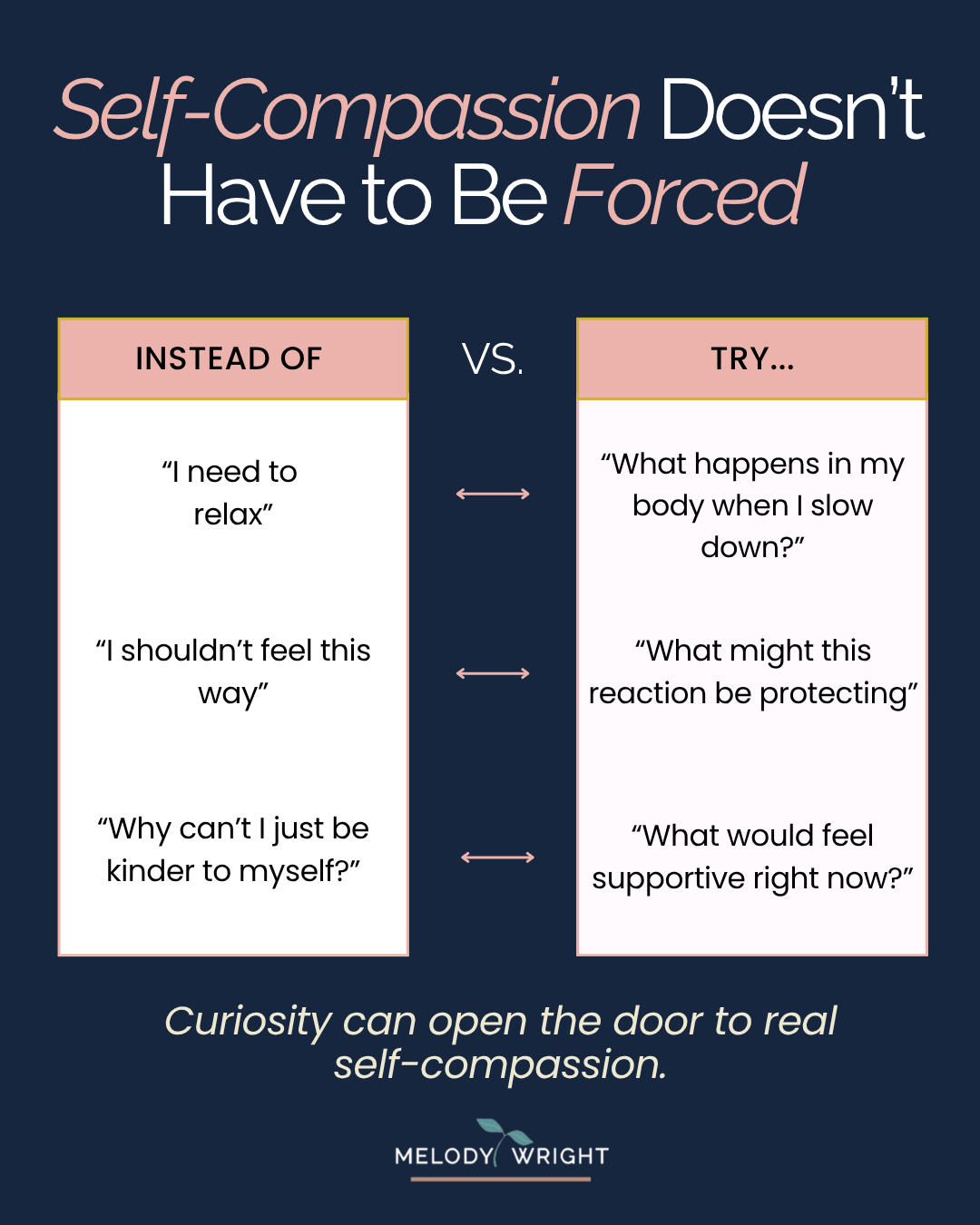
So rather than forcing yourself to relax or repeating a comforting statement until it feels true, you might begin with curiosity instead.
What happens when you slow down? Where do you notice the discomfort? Does your body feel safer keeping your eyes open? Moving around? Choosing words that feel less emotionally intense?
And honestly, sometimes the most compassionate response isn't pushing through the exercise. It's simply recognizing, "This doesn't feel supportive right now," and giving yourself permission to try a different approach.
Final Reflections
If there's one thing I hope you take away from this, it's that self-compassion isn't about pretending things didn't happen or convincing yourself everything is okay.
It's about discovering that you can respond to yourself differently.
Over time, those small moments begin to give your mind and body a new experience. You can make a mistake without attacking yourself. You can disappoint someone without automatically assuming you've failed them. You can acknowledge your own needs without treating them as evidence that you're asking for too much.
Little by little, self-compassion becomes more believable. Not because you've found the perfect words, but because you're discovering that pain doesn't have to be followed by punishment.
If being kind to yourself still feels uncomfortable, that's okay. As we've explored throughout this blog, those patterns often developed for a reason. And just as they were learned, they can also be understood and, over time, gently reshaped.
If you'd like support as you begin that process, that's exactly the kind of work we do in therapy. At Life by Design Therapy, we offer holistic, trauma-informed, and somatic therapy to help people better understand these patterns and build new ways of relating to themselves. Whether you're looking for therapy in Berkeley or online therapy anywhere in California, we're here to support you. If you're ready to begin that journey, we'd love to connect.
This Week's Affirmations
I don’t have to force kindness; I can begin with honesty.
My needs are not an inconvenience.
I am allowed to rest before everything is finished.
Making a mistake does not mean there is something wrong with me.
I can listen to my inner critic without letting it control my choices.
Additional Resources
If you’re interested in exploring self-compassion, quieting your inner critic, and building a kinder relationship with yourself, the books below can be a helpful place to start.
Self-Compassion: The Proven Power of Being Kind to Yourself by Kristin Neff
Radical Acceptance: Embracing Your Life With the Heart of a Buddha by Tara Brach
The Untethered Soul: The Journey Beyond Yourself by Michael A. Singer
Emotional Intelligence: Why It Can Matter More Than IQ by Daniel Goleman
The Power of Now: A Guide to Spiritual Enlightenment by Eckhart Tolle
**Some product links are affiliate links, which means we'll receive a commission if you purchase through our link, at no extra cost to you. Please read the full disclosure here.

