
By Melody Wright, LMFT
Have you ever been sitting with your family, halfway through dinner, only to realize you haven't actually heard a word anyone has said for the last few minutes?
Your body is there, and you're physically present, but your mind is somewhere else entirely.
Maybe you're replaying a conversation from earlier in the day.
Maybe you're worrying about something happening next week.
Maybe you're mentally running through every possible outcome of a situation that hasn't even happened yet.
If you've experienced this, I’ve been there. One of the most frustrating parts of anxiety is that it has a way of pulling us away from the life happening right in front of us.
The hard part is that many people assume they're simply distracted, unfocused, or overthinking. But anxiety is doing something much deeper than that.
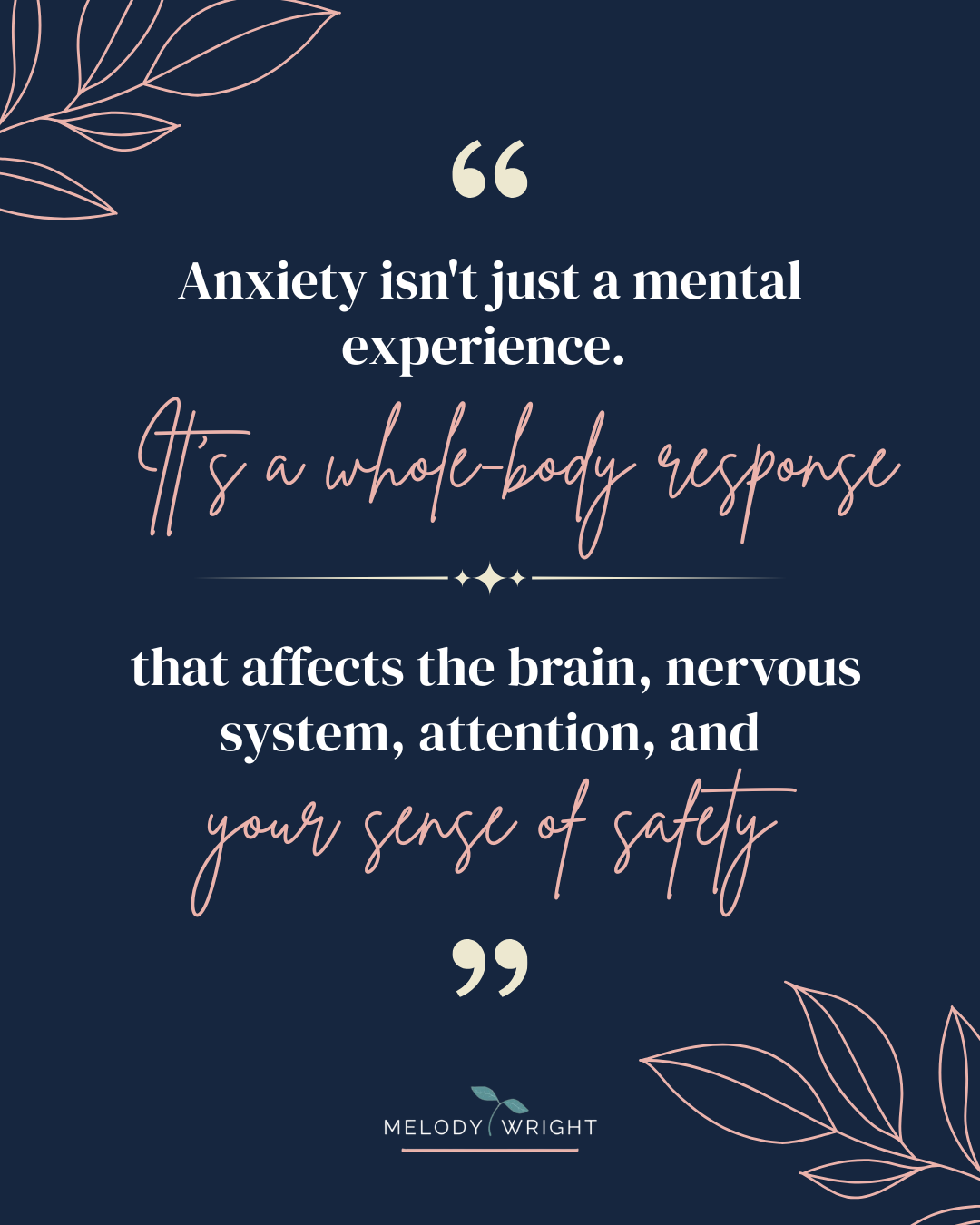
Anxiety isn't just a mental experience. It's a whole-body response that affects the brain, nervous system, attention, and your sense of safety.
And understanding what's happening can help explain why grounding techniques are often so effective.
What Anxiety Actually Does to the Brain and Body
At its core, anxiety is designed to protect us.
Your brain is constantly scanning for potential threats. Most of the time, this happens automatically and outside of your awareness. When your brain perceives something as potentially dangerous, your body's survival systems begin preparing you to respond.
The amygdala is the part of your brain that plays an important role in detecting threats and becomes more active. Stress hormones like cortisol and adrenaline are released. Your heart rate may increase, your muscles may tense, and your attention begins narrowing toward whatever feels threatening.
This response can be incredibly helpful in situations where danger is actually present.
The challenge is that our nervous systems don't always distinguish between a threat that is happening right now and a threat we imagine could happen in the future.
In both cases, your body may begin preparing for action.
This is why anxiety often shows up as:
Racing thoughts
Muscle tension
Restlessness
Difficulty concentrating
Trouble sleeping
Feeling "on edge"
A sense that you always need to be prepared
Your nervous system is just trying to keep you safe.
But in the process, it can become difficult to stay connected to the present moment.
Anxiety has a way of pulling our attention away from what's happening right now. Sometimes it keeps us replaying something that already happened. Other times it sends us racing ahead, trying to predict, prepare for, or prevent what might come next. Either way, our mind is no longer fully connected to the moment we're actually living.
Why Anxious Thoughts Pull Us Out of The Present Moment
Your brain is designed to look for patterns and keep you safe. So, when anxiety is active, that protective system can become overworked.
Instead of helping us respond to what's happening in front of us, it starts searching for problems that haven't happened yet, replaying situations that already ended, or scanning for signs that something is wrong. Your nervous system’s goal is protection, but the result is often exhaustion.
The more our attention is pulled away from the present, the harder it becomes to notice the things that actually help our nervous system settle: the chair supporting us, the sound of birds outside, the feeling of our feet on the floor, or the fact that, in this moment, we may be safe.
You might catch yourself thinking:
What if I fail?
What if something goes wrong?
What if I make the wrong decision?
What if I can't handle it?
If that sounds familiar, know that there's nothing wrong with you. These thoughts usually come from a place of wanting to feel safe. Your mind is trying to protect you by looking ahead and searching for answers.
The problem is that anxiety rarely settles for one answer. Even when you come up with a solution, it often responds with another question, another possibility, or another thing to worry about.
Before you know it, you've spent so much time living in "what if" that you've lost touch with what's actually happening right in front of you.
And when your attention is constantly being pulled toward the future, it can become really difficult to stay connected to the present moment.
Which brings us to another important piece of the puzzle.
How Anxiety Creates Disconnection From the Present Moment
When anxiety becomes loud enough, it can begin pulling us away from our actual experience.
You might find yourself driving somewhere and realizing you barely remember the drive.
You might struggle to enjoy a vacation because your mind keeps focusing on what needs to happen when you get home.
You might be spending time with people you love while simultaneously worrying about something that hasn't happened yet.
In many ways, anxiety hijacks attention. So, rather than allowing us to fully engage with what's happening around us, it continually redirects our focus toward potential threats, future problems, or worst-case scenarios.
Sometimes this can even create a sense of disconnection from your own body.
You may notice that you're living primarily in your thoughts.
Thinking.
Planning.
Analyzing.
Preparing.
But not fully experiencing the moment you're currently in, and this isn't because you're doing something wrong.
It's because anxiety is asking your nervous system to prioritize survival over presence.
The good news is that there are ways to gently help your mind and body reconnect.
And that's where grounding comes in.
Why Grounding Can Help
One of the biggest misconceptions about grounding is that it's supposed to instantly make anxiety disappear. That's a lot of pressure to put on any coping skill.
In reality, grounding is often less about getting rid of anxiety and more about helping your nervous system recognize that it is safe enough to return to the present moment.
When anxiety pulls your attention into future worries, grounding helps redirect your attention back to what's happening right now.
Back to your body.
Back to your environment.
Back to the information your senses are receiving in the present moment.
Research has shown that grounding practices can help interrupt spiraling thought patterns, increase present-moment awareness, and support nervous system regulation.
So, in other words, grounding helps create a bridge between where anxiety has taken you and where your life is actually happening.
Understanding why grounding works is one thing, but finding techniques that work for your specific nervous system is another.
If you're looking for practical ways to begin, check out our blog, 5 Body-Based Grounding Techniques, where we walk through several simple grounding exercises you can start using today. You can also download our free Mind-Body Toolkit for 50 exercises designed to help you reconnect with the present moment.
But while grounding can be incredibly helpful, it's important to remember that it isn't always addressing the reason anxiety showed up in the first place.
How Therapy Can Help Address the Root Causes of Anxiety
Grounding helps you come back to the present moment, but therapy can help you understand why your nervous system keeps getting pulled away from it.
For some people, anxiety is connected to chronic stress.
For others, it may be connected to trauma, attachment wounds, perfectionism, burnout, major life transitions, or experiences that taught the nervous system the world wasn't always predictable or safe.
Over time, therapy can help you identify these patterns, understand how they developed, and build new ways of relating to your thoughts, emotions, and body.
So, rather than constantly fighting anxiety, many people begin learning how to understand it.
And that understanding often creates more space for regulation, self-compassion, and lasting change.
Final Reflections
Anxiety has a way of convincing us that our attention belongs somewhere else, in tomorrow's problems, yesterday's mistakes, or endless possibilities and unanswered questions. But your life isn't happening in any of those places. It's happening here, right now.
And sometimes the goal isn't to force yourself to stop worrying. Sometimes the first step is simply helping your nervous system find its way back to the present moment. Through a single breath, a sensation in your body, or a grounding exercise, you can begin reconnecting with what's happening around you instead of getting pulled into what might happen next.
But if anxiety is making it difficult to stay present, therapy can help you better understand what's happening beneath the surface and develop tools to support lasting change. Book a call today and learn how we can help you reconnect with yourself, your relationships, and the life happening right in front of you.
This Week's Affirmations
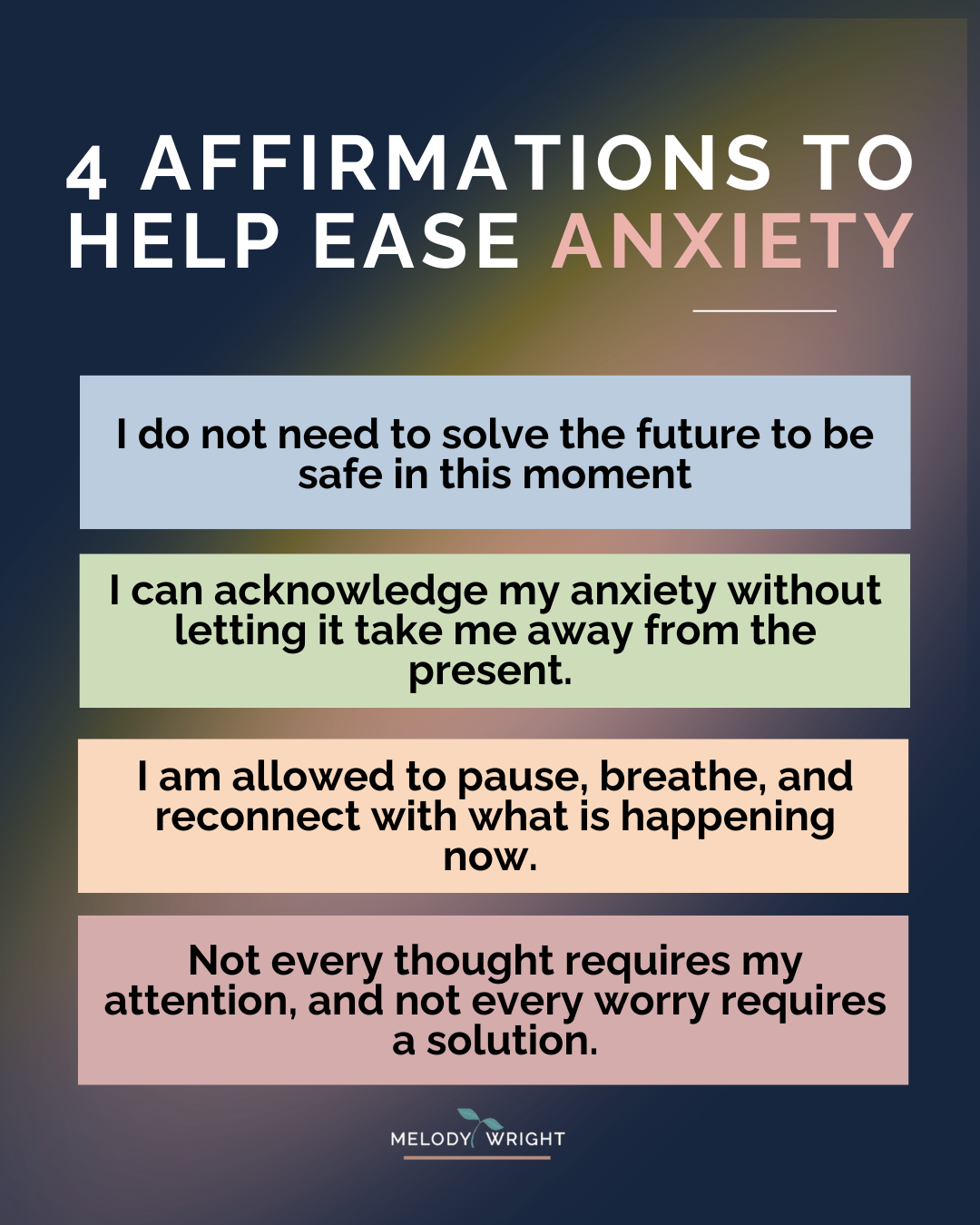
I do not need to solve the future to be safe in this moment.
I can acknowledge my anxiety without letting it take me away from the present.
I am learning to trust myself, even when uncertainty is present.
I am allowed to pause, breathe, and reconnect with what is happening now.
Not every thought requires my attention, and not every worry requires a solution.
Additional Resources
If you'd like to learn more about anxiety, grounding, nervous system regulation, and how anxiety can pull us away from the present moment, the books below offer helpful insights and practical tools to support your journey.
The Body Keeps the Score: Brain, Mind, and Body in the Healing of Trauma by Bessel van der Kolk M.D
Polyvagal Theory in Therapy: Engaging the Rhythm of Regulation by Deb Dana
The Power of Now: A Guide to Spiritual Enlightenment by Eckhart Tolle
Wherever You Go, There You Are: Mindfulness Meditation in Everyday Life by Jon Kabat-Zinn PhD
The Miracle of Mindfulness: An Introduction to the Practice of Meditation by Thich Nhat Hanh
Radical Acceptance: Embracing Your Life With the Heart of a Buddha by Tara Brach
**Some product links are affiliate links, which means we'll receive a commission if you purchase through our link, at no extra cost to you. Please read the full disclosure here.

